By James Grimmelmann
Last updated April 2026
I like to help junior scholars find their footing and their voice. Here are some of the suggestions I find myself giving again and again.
There are many ways to be a scholar, and none of them is the best. There is only what is best for you. Everyone has a different writing style, a different sense of what arguments are worth making, a different way of responding to objections. You will do better work—and be far happier—if you try to be the best version of yourself, rather than trying to be someone else.
Well-meaning people, including me, will tell you what to do. All of it is good advice for someone, but it may not be good advice for you. Listen carefully, and weigh it seriously—and then, if you know it won’t work for you, quietly set it aside and move on. Nothing anyone tells you is set in stone. That includes everything on this page. If you know I’m talking nonsense, ignore me.
A corollary is that you must not compare yourself too much to your peers. If you go down that road too far, it ends with you doing the same thing as them, only worse, because you will always be better at being you than at being them. You have to trust in your own ideas and your own processes enough to see them through, even when it looks like others are rolling from triumph to triumph. Everyone has inner struggles you can’t see; everyone has periods of great fortune that no one—not even them—can replicate on purpose.
Think about the scholarship you admire. What about it inspires you? Is it clarity? Empathy? Meticulousness? Imagination? Elegance? Precision? Humility? Wit? Rigor? Whatever it is, you can do it too. Through effort and practice, you can imbue your own work with the same qualities.
Now think about the scholars you admire. Whose way of being in the world seems like something you would like for yourself? Some people are ambitious; others are humble. Some are intense; some are relaxed. Some are serious; others are playful. Some live on the road; some are homebodies. They all made life choices to become the way that they are. You can make those choices too.
The same goes for negative examples. When you’re disappointed by a paper you read, ask yourself what you would have done differently—and then do that instead. If you see a senior figure in your field behaving in a way that strikes you as stressful and exhausting, remember that you are free to imitate only what you admire about them, and leave the rest behind.
It’s important to act like the kind of scholar and person you want to be, because acting like one is how you become one. (Vonnegut: “We are what we pretend to be, so we must be careful about what we pretend to be.”) Do it now, because “next time” has a way of turning into “never.”
Just as important as your role models are your peers. Figure out whose company you want to keep, and keep them close. Who gets you? Who has the same ambitions? Who brings out the best in you? Seek out kindred souls; they will be your treasured friends and colleagues for decades.
The same goes for the communities you want to be part of. Ask your mentors and your more senior colleagues what’s out there: the conferences, workshops, and publication venues that are right for you. It’s easy to drift into only submitting to the big huge outlets because that’s where everyone in your program publishes. But your specific interests should take you to more specific events. Find the rooms full of people who have the same obsessions you do, the places where people present the kinds of work that make you feel at home.
The Malcolm Gladwell version of the 10,000-Hour Rule is a myth, but the underlying idea is obviously true. You get better at things by doing them, so do the things you want to get better at. If you want to be a better reader, read. If you want to be a better writer, write. If you want to be a better public speaker, speak in public.
A few corollaries are less obvious. The first is the sports aphorism to practice like you play. If you spend your time doing something that is somewhat but not really like the skill you want to develop, you will end up with that and not with what you wanted. If you write small, incremental papers because anything more ambitious feels like too much of a risk, you will only get good at writing small, incremental papers. If you take shortcuts and read in a hurry, you will get good at taking shortcuts and reading in a hurry. You have to do the thing itself.
The second is to embrace failure. Don’t expect to be good when you start doing something new. Do it anyway. Think of yourself as a beginning musician playing notes to see how they sound together, or a beginning artist mixing paints to see what colors result. Create things purely for yourself. Fail fast and fail often. Love your mistakes, and learn from them. Make a mess, clean it up! The only way out is through.
Your time is abundant; your time is scarce. You will always be torn between different things you could be doing: reading, writing, teaching, networking, exercising, partying, dating, parenting, and plain old relaxing, to name just a few. Time management can be especially hard when you have to balance a few large long-term goals—write a law-review article, say—with smaller tasks that are individually less important but collectively necessary. Get used to living with the question “What should I do now?” It will be with you for the rest of your career, and you will have to learn how to think about it without overthinking it.
The first thing to say is that lawyerly evasion, “It depends.” Most of all, it depends on your working style. You do you! Some people work well under deadline pressure, and for them strategic procrastination can be an effective strategy. Others need regular daily routines, and for them small and steady progress is the way to go. Pay conscious attention to what works and doesn’t work for you. Embrace what does and change what doesn’t.
It also depends on your mental and physical status. I have learned, for example, that I can write scholarship effectively only in a flow state. I can get myself into one reliably, but I have to have a substantial block of time and I have to be relaxed. If I’m excited (good) or agitated (bad), writing will not happen and I need to do something else instead. Pay attention to what your body is telling you and choose what to do next accordingly. Sometimes it’s “have a snack” or “go for a run”; sometimes it’s “format citations” or “find someone to help you talk through an idea.”
I find that it’s better to look backwards than forward. When you go to sleep at night, you should feel good about the day. Ask yourself, “Did I do something meaningful today?” rather than worrying about what you need to do tomorrow. When you wake up tomorrow, pick something to work on that you’ll feel good to have accomplished. When you look ahead, sometimes all you can see is a stress-inducing mountain of unfinished tasks, or you’ll unconsciously double- and triple-book your time. But in hindsight, you can take comfort that even if you didn’t do everything you might have hoped to, it was only because your hopes were unrealistically ambitious. As long as you did what you could, that’s all that anyone can ever ask of you.
When you’re reading for a specific project, you’ll need to read everything in the literature that bears directly on it. The rest of the time, do your best to read widely rather than deeply. It’s much easier to bring in something useful from another part of your field than it is to invent something new in your subspecialty. You’ll be more creative, you’ll be part of more interesting conversations, and you’ll have more fun.
A good heuristic is the principle of maximum surprise. Find the weak spots in your knowledge, and steer into them. If you know exactly what a paper is going to say based on the abstract, reading it is a waste of your time. Look for articles where you have no idea what to expect, where every sentence comes as a revelation.
Non-academic reading is important, too. Read the news, read blogs, read newsletters and tweets and mailing lists and poems and novels. Watch short-form viral videos and long-form YouTube explainers. If it lights up the same part of your brain that gets happy when you read a good article, it’s relevant enough that you should feel fine about reading it on “work” time.
The world is wide and weird, and most of it will never make it into academic journals. In many fields, you can’t be an effective scholar unless you’re following current events. Laypeople are often far better at spotting an issue or explaining a point than academics are. But mostly, you’ll enjoy reading widely and weirdly, and isn’t that reason enough?
The end of a good research agenda (in law, at least) should include a list of article ideas, described in a sentence or two each. It’s fine if they’re unrelated to each other, and it’s fine if many of them don’t directly bear on your main research interests. The point is not that you intend to write all of them up immediately, in order. The point is to demonstrate that you are a bottomless fountain of ideas and you will never be at a loss for something worthwhile to write about.
Now forget about the research agenda that you share with others. Make yourself a list of ideas to write about, a list so long you couldn’t possibly cover all of them in two lifetimes. Some of them you’ll get around to. Some will be preempted because someone else did it first and better. Some you’ll look into and realize that the idea itself was bunk. And some will sit there because you had more urgent projects to take on. All of this is fine. The list isn’t there to tell you what to write next. It’s there to inspire you, to remind you that you have options, to keep you from falling into a rut.
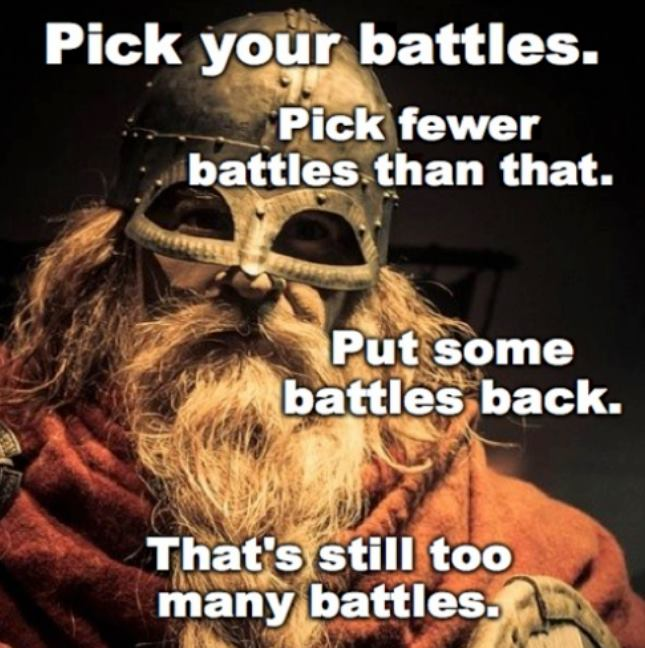
Pick fewer battles than that. Put some battles back. That’s still too many battles. I understand that I’m a terrible role model. But believe me when I say that my work would be much better if there were 25% less of it.
You can’t do everything. You can’t even do as many things as you think. Most of your professional life will have to be saying “no” to things that would be wonderful—if they were the only thing on your plate. Some of my friends have “no”-buddies, who praise each other whenever they say “no” to a request to do something. Others keep punch cards: when they accumulate ten “no”s they’re allowed to say “yes” once.
Real artists ship. You have accomplished something worthwhile not when you start a project but when you share it with the world. It’s fine to put an hour or two into making notes or writing up the basics of what you’ll need to remember an idea later. But you shoudn’t start a project in earnest unless you are willing to take one of your other projects and accept that you may never complete it. Opportunity costs are very real, and you should devote your time to the projects that are most worth doing—compared to all the other wonderful projects you could be working on.
Many articles say that they “fill a gap” in the literature. The phrase is a cliché, but the impulse is good. There’s a common tendency in legal scholarship to write a paper that is 90% recap and 10% novel. Fight it! Write papers that are 10% recap and 90% novel.
It’s easy to break this rule unintentionally. You’ll learn something exciting, or have a revealing insight, and want to share it with the world. But just because something is new to you, that doesn’t automatically mean that it’s new to the community of scholars. I’ve found that my view of a topic is often shaped by the way I first learned it from a course or a book—along with whatever biases and blinders that first source had. Distrust your own knowledge. No idea is worth working up until you have done a literature review.
In particular, you always need to ask whether a new idea is just an old one in a mustache and glasses. Is there a doctrine that already does the necessary work? If there were, where would it show up in the caselaw and commentary? What would it be called? Most of the time—not all but most—I find that there’s already a good answer to my question. Instead of writing something up myself, I cite the existing work and move on.
There is no point in writing what everyone expects. Surprise yourself; surprise your readers. You don’t need to radically reimagine everything—if that’s your goal, you should probably be an artist rather than a scholar—but an article that never startles or unsettles probably isn’t worth writing. Fields of study tend to run in the same grooves again and again; steer off the road and it may be harder going but the scenery is far nicer.
For obvious reasons, this is a hard habit to cultivate. Making yourself into a bottomless fountain of ideas is a good start, because having more choices of what to work on helps you pick out the more interesting ones. Another helpful technique is to write in haste and edit at leisure, because you’re more likely to shake loose interesting ideas if you’re not overthinking it. There will be plenty of time later to see whether a quirky example or startling juxtaposition really works—but if you don’t write it down while you’re thinking of it, you won’t even get the chance to test it properly.
If you want people to understand your paper and build on it, everything about it needs to be as clear, as memorable, and as simple as it can possibly be. Literal elevator pitches aren’t the best way to convey ideas, but as a genre of writing, the elevator pitch rightly emphasizes these virtues. Of the three, I find simplicity to be the best starting place, because without it the other two are impossible. Here are a few techniques I use.
First, don’t be afraid to go visual and tactile as you work out the moving parts of your argument. I’m a big fan of putting everything on a whiteboard, or writing each piece on an index card and moving them around the floor. If you want to make a conspiracy wall, go for it. Arrange and rearrange until you have found the minimal set of concepts that explain your idea. Circle them, and then put everything else in its proper ordered relationship to them. A paper’s pieces should come in an order that feels inevitable; if you’re using a lot of infras, you’re doing something wrong.
Second, the highest-stakes parts of your paper—the title, thesis, and abstract—need to be the most straightforward. Wordsmith them intensely. Try out variations. Read them aloud. Try rewriting them in Up Goer Five style (interactive dingus). Don’t rest until you feel confident you could explain the paper to a half-drunk friend of a friend at a noisy party. (Side benefit: it will make parties more fun.)
Third, give each paper as much time in the rock tumbler as it needs to shine. Read through the paper, top to bottom, fixing everything you can find that is awkard, confused, or wrong: spelling, wording, metaphors, paragraph flow, section order, and everything else large or small. Think about the paper on and off for two weeks but don’t look at it—then come back and go through it top to bottom again. Repeat as many times as you can stand. This is how you clean off the grit that obscures the elegance of your argument. Good work takes time, and time takes patience.
The quality of a life is not measured in years; the quality of an article is not measured in pages.
Never write filler. Make every section and every sentence worth reading. If the genre demands certain conventions, deal with them as succinctly as possible and move on. Respect your readers’ time and intelligence, and they will respect your efforts.
If you find yourself writing the same thing more than once, something has gone very wrong. The first time you write on an issue should also be the last unless you have something new and different to say. This means that articles should be comprehensive. They should cite (and as needed discuss) any sources that someone reading the paper should know to understand the issue. Sprawling string cites in footnotes are useful if—and only if—they give the reader all of the necessary references for further reading.
Some ideas are big; some are small. Don’t try to cram a big idea into a short paper, or to stretch a small idea into a long one. Some questions need to be worked out calmly and methodically; others are best tackled in one sitting in a white heat. Write in the genre that the idea itself tells you that it belongs in.
Sometimes, a paper surprises you as you’re writing it—your examples turn out to be redundant with each other, say, or a doctrinal point you thought would be easy to pin down wriggles out of your grasp. It’s not always within your control, but to the extent that you can, let the paper guide you to its new form. Don’t be afraid to insert an entire section even after the paper has been accepted; don’t be afraid to cut out pages of material if they’re not important to your argument.
That said, never throw away anything you write. When you cut out part of a paper, put it somewhere you can find it in case you want to paste it back in later. I keep files with names like “Consenting to Computer Use Scraps.” They contain anything I wrote that I decided wasn’t working, and when I finish a draft I look through the corresponding scraps file to see if there’s anything useful. Similarly, keep a junkyard of your abandoned papers and excised passages. Sometimes, the specialized part you need for a new paper will be sitting right there, ready for recycling. Some of my favorite articles are built around material that had been sitting in my junkyard for a decade.
This is also about the intellectual integrity of your work. Explain your ideas clearly and honestly, and answer any serious objections you can think of. Beyond that, it is not your job to psychoanalyze your potential critics. Don’t try to make them happy if it means muddling your arguments or advancing claims you don’t really believe. Let them object! The article itself should answer them—or if not, you should be grateful for their critiques.
We’re in this business because we care about sharing knowledge. It’s almost willfully perverse to go through the immense effort of writing a work of scholarship, only to let it languish in obscurity where only a few people can read it. Although it’s not always possible to publish your work under fully open-access terms, you should do your best to make it as open as you can. I have found that almost all law reviews have author agreements that are compatible with Creative Commons licenses and are happy to put an explicit license grant in the author footnote.
Relatedly, do what you can to make your scholarship easy to download. Although law-review websites typically make articles available as PDFs, they are notoriously unstable, and tend to make breaking changes to the URLs in their archives every five to ten years. Repositories are good, and you should make sure that your articles are available in appropriate ones, like SSRN and arXiv. If you post a draft, come back after publication and add the full citation and the most authoritative version you’re able to. Even better, self-host your papers too, with direct PDF download links.
A personal website is your best chance to make a good first impression on potential colleagues and students; present yourself the way you want to be seen. Get a custom domain (your full name is a good default) and put up a professional homepage. The absolute minimum is a brief biography, a short summary of what you work on, your CV, and working links to all of your publications. A picture of you is optional, but I recommend it. (If you think a photograph is too boring, a painting, sketch, pixel-art rendition, or other human-made artistic depiction can also work.)
Treat your website as a long-term commitment. Update it as you add publications or professional accomplishments. You can build out other content over time, but in general you shouldn’t add something unless you’re willing to take on the associated maintenance for years to come. Above all else, do not let the domain name expire.
A social-media presence is optional. If you do have one, think about what tone you want to project, because it’s going to stick with you for a long time. Sarcastic or earnest? Pugnacious or even-tempered? You do you.
Every few years, a famous professor at a fancy law school publishes an article that gets the law badly wrong or plagiarizes from the souces it discusses. On investigation, it transpires that the professor copy-pasted text from a research assistant’s memo into an article draft. It’s not a good look, but it’s an obvious and forseeable risk of putting an RA’s work product anywhere near your own.
The same is true of generative AI. If you want to be a serious scholar with academic integrity, you should not let generative AI anywhere near your writing, not ever. If you use generative AI for writing-adjacent tasks, you will face a constant temptation to accept its outputs without reviewing them carefully line by line. You may even trick yourself into a kind of normalized deviance based on the fact that you’ve been using generative AI and nothing has gone catastrophically wrong yet. Emphasis on yet. Sooner or later you will end up with listeria in the liverwurst.
The essential promise of any honest scholar is that you are personally responsible for every word you publish. Overreliance on generative AI can will lure you into complacency and inattentiveness—only to betray you with hallucinations at the worst possible moment. Don’t put yourself in a position where you run the risk of screwing up this badly.
If that doesn’t convince you, consider the following, from T.W. Körner’s The Pleasures of Counting:
The plans for the San Francisco metro BART called for the trains to be fully automated but to carry a conductor in case of emergencies. It was pointed out that the kind of person who would be happy to ride back and forth without doing anything for nine years would be precisely the person least capable of coping with an emergency in the tenth.
Don’t deskill yourself. If you use AI to produce good-enough prose with decent arguments, you will never become capable of writing great prose with ironclad arguments. Even if there’s never a disaster, do you want to be the kind of scholar who is happy to ride back and forth for nine years without doing anything?
Typesetting your writing is like showering before going out in public. Even people who don’t consciously notice will appreciate it, and you will feel more confident and professional. Spend some time with Matthew Butterick’s Typography for Lawyers. The website is good, but it’s worth owning the book in hard copy. (If you want to go deeper, also read Robert Bringhurst’s The Elements of Typographic Style.) Essential rules to follow include using curly quotes, avoiding system fonts, proper line and paragraph spacing, and a reasonable line length. A nice next step is to pick a good font for your drafts and use it consistently.
It goes without saying but is worth emphasizing that you should always use people’s preferred names and pronouns. That includes spelling their names correctly, something that I’m particularly attuned to as a two-ns-at-the-end Grimmelmann. For non-English names in Latin scripts, use proper accents and diacritics. For names in other writing systems, use a typeface in that writing system where appropriate, and use the person’s preferred Romanization or an authoritative system (e.g., pinyin) when transliterating.
Your students are in your care; take good care of them. Bring your A game to your teaching; convey with every word and gesture that you are there for them. When you walk through the door of the classroom, let everything else drop away. You should be prepared, focused, and happy to be there. Do your best not to let whatever else is going on in your life take away from your teaching. Your problems are not your their problem.
Be accessible and welcoming outside of class, too. Some professors set out bowls of candy for their students in office hours; others sit down for lunch in the student commons and talk to anyone who joins them. Respond to your students’ emails promptly, listen to their concerns sympathetically, and give them the best advice that you can. It’s fine to have work-life boundaries, and you don’t need to devote every waking minute to your students. But they need to feel that you welcome seeing them, and that if they need to come to you with something important, they can.
You also need to be there for all your students. Don’t play favorites: they have enough stress already without feeling that every interaction is a competition. Your approval should not be conditional on how well they do in your class. I’ve had wonderful students who got mediocre grades but more than made up for it in their careers with pluck and hustle. Some of your students will have political views you disagree with. Set that all aside. You owe them just as much as you owe any other student. It’s literally your job.
Don’t build up a cult of personality around yourself. Good teaching is skilled professional labor, nothing more and nothing less. It isn’t about an intimately personal exploration of life’s mysteries; it doesn’t require deep devotion on your students’ part. If anyone could write a titillating campus novel or a glossy magazine feature about your teaching methods, you’re doing it wrong. Make it clear that the reason you’re in the front of the room is because you have spent years putting in the work, not because you have some special inborn insight that only you can impart.
At the same time, don’t go to the other extreme and act like you’re one of them. You’re not a student; your students are not your peers. There’s inherently a power imbalance in your relationship, and it does no one any favors to act like there isn’t. Don’t go on this-stays-in-Vegas trips with your students; don’t tearily tell them about your love life; don’t gossip with them, especially about other students. And absolutely under no circumstances get into a relationship with them or do anything that give someone reasonable cause to think that it’s a possibility you would ever contemplate.
Watch Patrick Winston’s lecture on How to Speak. I saw him give this talk live when I was in college, and it became the foundation of my own presentation style. I don’t agree with all of his advice, but if you start off by doing what he suggests, you will quickly reach a point where you can make good, informed choices about what works for you and what doesn’t.
Write out what you plan to say, word for word. Practice delivering your talk, out loud, repeatedly. You will quickly discover awkward phrases, missing steps, extra words, and many other things you can fix. Fix them, and then go through the talk again, out loud. By the time you are delivering it live and under fire, you may find that you can recite it from heart. That’s fine. It served its purpose by getting you to the point where you don’t need it. If you do this with every talk you give, after a few years you will find that you can give a good talk with increasingly skeletal notes. Doing this for every class you teach is overkill, but I highly recommend a detailed outline of every point you plan to make and question you want to ask. After a decade or two, you will be able to walk into a room cold and give a tight, coherent 45-minute lecture.
Slides can be extremely helpful, but there is nothing more boring than a speaker reading off what their slides say. Think of your slides and your words like the images and the audio track of a movie, or like two voices moving in counterpoint: they should complement each other. One good technique is to put up a striking image or diagram, and then tell your audience what to see in it and why it matters. Another is to have slides that signpost the steps of your argument so that the audience is always oriented. (An advantage of this approach is that the slides are a concise version of a transcript; someone reading them can quickly get the gist of what you said.) To keep things moving, use a simple template with a generous font size (I like 40-60 point). It doesn’t just make your slides look better; it forces you to explain yourself concisely, and that improves the talk.
At least in law, questions are the most important part of a talk, and you need to do several things in answering them. First, and most obviously, you’re defending your argument. You don’t need to refute every critique—learning from your interlocutors is important part of being a good scholar—but you need to defuse any objection that would blow a hole in your claims beneath the waterline. Second, you’re showing that you know your stuff: a good answer shows that you know where your questioner was going with it, and how the question relates your work to the broader field. And third, in a job talk you’re showing that you’re a sharp and interesting person who would be good to have as a colleague. A good job talk Q&A is like a friendly game of tennis: they don’t care who wins, they want to know whether you’re fun to play with because you can get to the ball quickly and hit it back in skillful and surprising ways.
If you stay in academia for long—if you stay in any job for long—you will quickly learn who is reliable and who is not. Some people turn in their symposium drafts and tenure letters on time; some people don’t. Some people answer their emails; some people don’t. Some people show up for meetings; some people don’t. Be the reliable kind of person, not the other kind. I’d like to say it’s professionally useful, because people will trust you with more important responsibilities, and to some extent it is, but really it’s about being respectful towards your colleagues, who are struggling every bit as much as you are.
The first step towards being reliable is to pick your battles. If you’re having trouble keeping up with the existing demands on your time, don’t pile on more! It’s much better to tell someone “no” up front when they ask you to do something than it is to say “yes” and fall down on the job later.
If you do find yourself in a place where you’ve overpromised, be thoughtful about the order in which you tackle things. Anything where someone else is counting on you belongs at the top of the list. Counterintuitively, the less “important” the someone else, the more seriously you should take their needs. An undergraduate waiting on an exam grade is a higher priority than a co-author waiting on edits to a draft is a higher priority than a faculty advisor waiting on a progress report.
Communication is also key. A lot of crises can be averted if the person waiting on you knows you’ll be late, and knows why. If you need more time, say so! If you’re behind because you got sick, or your kid’s daycare is closed, say so! (Being forthright gets easier as you get more senior, or at least I got better about it as I got older.)
Start from a position of generosity. (You’re Wrong About is a great demonstration of how to act with empathy without compromising your principles.) The hermeneutic of suspicion is a miserable prison to trap yourself in. Every argument has something in it you can learn from. Use phrases like “please correct me if I’m missing something,” or “can you explain that in more detail” rather than rejecting an idea outright. If you can’t respond to something without getting angry, let it go entirely.
On the one hand, some schools, and some entire disciplines, have destructive cultures of criticism. It can start from a well-intentioned place, but it often evolves into an ugly ritual of dominance and humiliation. Steer clear. These blood sacrifices turn participants into bad scholars and worse people. A hole in a colleague’s argument is not a moral failing or a condemnation of the paper; it’s an opportunity to take what they already have and do more with it.
On the other hand, some communities reflexively wrap all their scholarly dialogues with effusive compliments. Don’t do that either. Be completely sincere. Don’t give false or empty praise. Skip straight to the substance of your comments or critiques. You do your colleagues more of a favor by telling them how they can improve their work than by mouthing platitudes about how good it is already. If you have a reputation for honesty, your praise will land with all the more force because it is clear that you really mean it.
None of this should stop you from calling out truly bad behavior or standing on your principles. It’s just that you should always look for amicable offramps when you can, and never be gratuitously mean. Make sure that your interlocutor really is saying what it seems like they are before you come for them. If all else fails, and you do need to give a critical response or write a takedown of a review, always hold something back. If you keep your best and most devastating point in reserve, you will have something to fall back on if they come back at you.
You owe the most to the people who are least able to look out for themselves. Be a mama bear for your students; maul anyone who comes for them. Look out for your colleagues and peers; support them when they need it. Honor your mentors by modeling what they’ve taught you and paying forward the favors they have done you.
Keep your promises. In particular, when you agree to write a recommendation letter or a tenure review, someone’s career can depend on getting it in as promised and on time.
Keep confidences as far as you can. Colleagues and students will trust you with their hopes, their fears, their stories, and their secrets. Justify that trust. Don’t lie, but learn how not to leak. Fortunately, this is something that lawyers are professionally good at. Sometimes, a Glomar response to an entire topic is appropriate. Also learn how to deflect curiosity invisibly. Hinting that you know something juicy that you’re not allowed to share can be as bad as sharing it. Sometimes, you’re required to breach confidentiality; most professors are mandatory Title IX reporters. Know your duties, so that you can warn someone before they start into telling you something that would trigger your reporting obligations.
Institutional loyalty is a different matter. The reason to care about your school—or anything else you’re part of—is for what it represents, what it could be at its best. You don’t have to support everything it does simply because you work there. Instead, you should do your best to make the place where you work worth supporting because it does what it should. How you do that is up to you. Some people prefer to work within the system for as long as possible; others are more willing to air their grievances publicly.
There are a lot of famous academics in the Epstein files. What they have in common—what explains their terrible lapses in judgment—is overweening pride. They saw themselves as the kind of fancy people who ride on private jets and visit private islands, the kind of elite intellectuals who prefer to associate only with other elite intellectuals, the kind of superstar scholars whose work is so important that it’s worth fawning over billionaires to support it. They failed essential tests of character long before they met Jeffrey Epstein.
It’s fine to be proud of your work, in the same way that parents are proud of their children and teachers are proud of their students. But don’t let it go to your head. To quote one of those Epstein-connected academics (Henry Rosovsky, in one of his better moments), “We are all common laborers in the vineyard of the arts and sciences—preserving, discovering, teaching.” It is the honest labor that is dignified and honorable; such success and recognition as we may sometimes through good luck enjoy are not the reason that the labor itself is worthwhile. Enjoy the thing itself; let praise roll off your back like a duck in the rain. Criticism from someone who understands what you’re trying to do is worth a dozen compliments from people who do not.
It’s also important not to go to the other extreme. Don’t let impostor syndrome mess with you. You don’t have to be the best in your field to justify your career. If someone else writes a paper you wish you had, first sincerely celebrate their accomplishment and then think about how you can do something similarly excellent the next time around, because you totally can. Your colleagues are your collaborators and cheerleaders, not your competition. You don’t need to be better than them, and don’t convince yourself that they’re better than you.
It is an extraordinary privilege to be a scholar. To quote Mark Twain,
Intellectual “work” is misnamed; it is a pleasure, a dissipation, and is its own highest reward. The poorest paid architect, engineer, general, author, sculptor, painter, lecturer, advocate, legislator, actor, preacher, singer is constructively in heaven when he is at work: and as for the musician with the fiddle-bow in his hand who sits in the midst of a great orchestra with the ebbing and flowing tides of divine sound washing over him—why, certainly, he is at work, if you wish to call it that, but lord, it’s a sarcasm just the same.
But with great privilege comes great responsibility. The students who pass through your school and the society that supports higher education have given you a gift. Earn this.
The bottom of my to-do list reads, “Do not put up with distracting bullshit—write real, useful scholarship.” Your definitions of what is “bullshit” and what is “useful” may be very different than mine, but try to live by this principle. You were put on this earth, and you sought out this job, for a reason. Do your best to create something true and enduring.
Financially, try to live beneath your means. Tenure-stream academics may not be paid to excess like superstar software engineers or biglaw partners, but we draw professional salaries that range from the middle of the middle class to its very upper reaches—plus we enjoy job security that most people can only dream of. It’s great to let the steady direct deposits of your paychecks take away the stress of worrying about covering your living expenses. But otherwise, try to maintain the same habits you’ve been living with as an underpaid student. Expensive tastes can put you in a place where you have to compromise your principles or your happiness. Your goal should be to be comfortable enough that you don’t need to worry about money, but not so comfortable that you don’t need to think about it.
And finally, try to live with the idea that this could all go away. I have seen schools close, and others fall into very hard times. There is an ongoing assault on academic freedom and even on the very idea of higher education itself. Think a bit about your exit plan, about what you will do if mere anarchy is loosed upon the world. Until that day (and it may never come), dance while the music plays.
Your advisors and mentors will—hopefully—do everything they can to help you develop into the best scholar and person you can be. But just like you are unique, so are they. Everyone has a different style.
In particular, and especially with your advisor if you are in a program with one, you need to be able to give them what they need to give you the best support they can. Some people need structured meetings with agendas that you prepare; others bring their own detailed checklists; still others are inspirational chaos muppets. Learn how to work with who they are.
Here’s an example: I discovered that one of my best mentors could only hear me talk about one idea in a meeting. If I brought them more, we would never get to them all because they would do a deep dive on the first thing I said. I learned how to pick the project I needed their help with most, and they gave it to me, brilliantly, on many occasions.
People with power will sometimes behave terribly toward you. They may make unreasonable demands on your time, pass off your work as their own, casually belittle your efforts, leave you out of conversations you should have been in, neglect their promises to you, and much more. But these are all them problems, not you problems.
Your first responsibility is take care of yourself. A close second is to take care of those around you. A distant third is to jump through the hoops that authority figures hold up for you. Do what you need to make it through. But don’t let it convince you that there is something wrong with you, and don’t let it convince you that this is how academia is supposed to be. You can be better, in every sense of the word.
If you will sometimes encounter awful people, you will also encounter wonderful ones. Know who your allies are, the ones who genuinely care about supporting each other through thick and thin. You will have to make difficult decisions about how much to confide in people, and while it’s never easy, it’s at least easier if you have thought in advance about who you can trust when the going gets touch.
Prestige and money sing a siren song. It’s easy to make career choices based on what the crowd considers important. But you aren’t the crowd. You’re you. Prestige and money can be means to an end. They can give you influence, if that matters to you, or flexibility, if that matters to you, or comfort, if that matters to you. But the things that matter to you matter because they matter to you. Far better to know what those things are, and to live toward them. Sometimes that means grabbing the brass ring; sometimes it means letting the ring go by.
Here is a selection of other scholars’ advice I have learned from. I don’t agree with everything they say, but everything they say is at least worth considering.
My thanks to the junior scholars who have given me suggestions on what this page should say, and who have gently corrected my many errors. I am more grateful to them than they can know.